NEMA Stepper Motor: Precision Motion Guide

All Categories

nema stepper motor

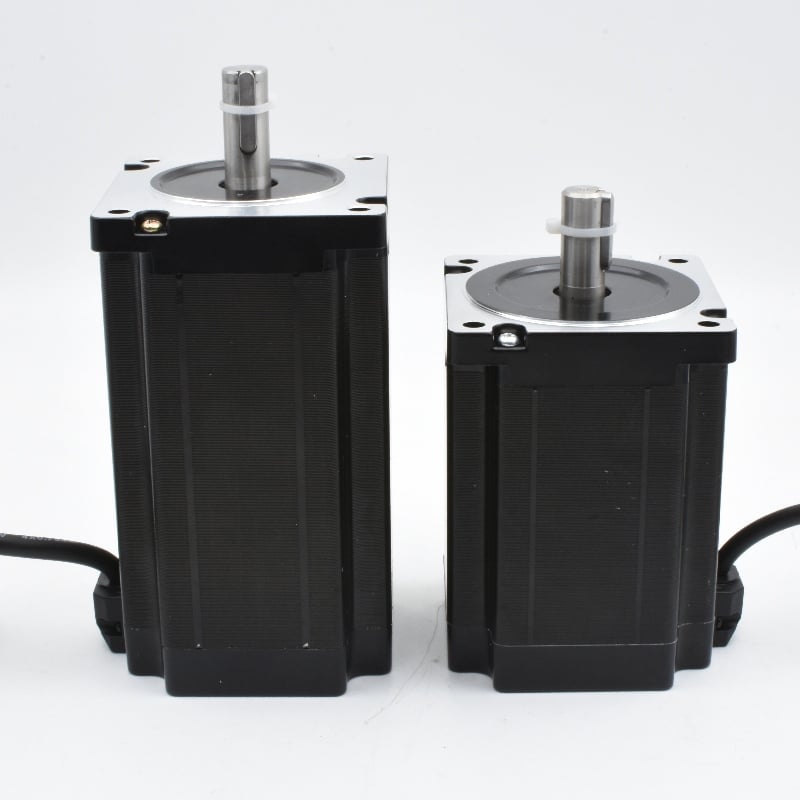
A nema stepper motor is an electric motor that turns electrical pulses into controlled, repeatable movement. Unlike a standard motor that spins continuously, a nema stepper motor moves through fixed angles called steps. This design lets a controller set shaft position, direction, speed, and travel distance without always needing a separate position sensor. The nema stepper motor is commonly identified by its NEMA frame size, which describes mounting dimensions rather than output performance alone. The correct model also depends on torque, voltage, current, step angle, speed, and available space. A nema stepper motor uses energized coils and a magnetic rotor to create motion. Its driver supplies current in a sequence, allowing full-step, half-step, or microstep operation for smoother travel and finer control. Modern nema stepper motor systems may include high-current drivers, closed-loop feedback, overheating protection, and communication interfaces. A nema stepper motor can hold its position when powered, making it useful for linear stages, feeders, valves, camera systems, and positioning equipment. Because a nema stepper motor produces strong low-speed torque, it performs well when a load must start, stop, or remain still accurately. The main function of the nema stepper motor is reliable positioning, but it can also support speed control and repeated indexing. Choosing a nema stepper motor requires matching the frame, shaft, wiring, and torque to the machine. The nema stepper motor offers a practical balance of control, durability, and cost. When a nema stepper motor is correctly sized, it delivers predictable motion with simple setup. Overall, the nema stepper motor suits equipment that values accurate movement, repeatability, and dependable operation.

New Product Recommendations

The biggest advantage of a nema stepper motor is precise, repeatable movement at a practical purchase cost. A controller sends pulses, and each pulse represents a known amount of rotation. This makes the nema stepper motor easy to coordinate with screws, belts, gears, and indexing mechanisms. For many machines, an operator can control position without adding an expensive feedback system. The nema stepper motor also produces useful holding torque while stopped. That feature helps a platform, tool head, or valve stay in place during a process. It reduces unwanted drift and supports consistent results. At low and moderate speeds, a nema stepper motor delivers strong torque, which benefits lifting, feeding, clamping, and positioning tasks. A nema stepper motor has a simple internal structure with no brushes to replace. With proper current control and cooling, it can provide long service life and predictable maintenance needs. Buyers can select different frame sizes, shaft styles, winding options, and torque ratings to fit both compact devices and larger industrial machines. A nema stepper motor works well in applications that require frequent starts, stops, and direction changes. It suits 3D printers, CNC routers, packaging equipment, laboratory instruments, textile systems, medical devices, and automated stages. The nema stepper motor can also operate with microstepping, which reduces vibration and creates smoother motion than basic full-step control. However, buyers should not choose by frame size alone. A nema stepper motor may lose torque at high speed, so the load, acceleration, duty cycle, and drive must be reviewed together. Proper sizing prevents missed steps, excess heat, and premature wear. For a cost-conscious machine builder, the nema stepper motor offers clear control, flexible installation, and dependable low-speed performance. The nema stepper motor is especially valuable when repeatable motion matters more than very high rotational speed. In short, the nema stepper motor combines accessible control with application flexibility and useful mechanical strength.

Tips And Tricks

Small DC Motor Efficiency: Brushed vs Brushless Models

21

Aug

Small DC Motor Efficiency: Brushed vs Brushless Models

When selecting a small dc motor for your application, efficiency represents one of the most critical performance metrics to evaluate. A small dc motor powers everything from industrial automation equipment to consumer electronics, yet not all models ...
View More
Small DC Motor Speed Adjustment: A Simple Tutorial

02

Sep

Small DC Motor Speed Adjustment: A Simple Tutorial

Controlling the speed of a small DC motor is one of the most practical and valuable skills in industrial automation, robotics, and equipment maintenance. Whether you operate conveyor systems, robotic arms, automated packaging equipment, or precision ...
View More
How a Micro DC Motor Powers Modern Surgical Tools

30

Oct

How a Micro DC Motor Powers Modern Surgical Tools

Modern surgical tools need compact, predictable movement that clinicians can control within a confined operating field. A micro dc motor helps provide that movement by converting electrical energy into rotation or, with suitable transmission, another...
View More
How to Custom Design a DC Planetary Gear Motor for Equipment

30

Oct

How to Custom Design a DC Planetary Gear Motor for Equipment

Custom designing a dc planetary gear motor for equipment starts with the job the motor must perform, not with a catalog size. Define the load, movement, duty cycle, and available space before choosing components. A well-specified dc planetary gear mo...
View More

Get a Free Quote

Our representative will contact you soon.
Email
Mobile/WhatsApp
Name
Company Name
Message
0/1000

nema stepper motor

Accurate Positioning Without Complex Control

Accurate Positioning Without Complex Control

A major selling point of a nema stepper motor is its direct response to digital command pulses. Each input pulse moves the shaft by a defined increment, so a controller can plan distance and direction with straightforward software. This makes a nema stepper motor valuable for equipment that must place a tool, tray, lens, or workpiece repeatedly. In many low and medium speed systems, the nema stepper motor can track commanded movement without a separate encoder. That reduces wiring, programming effort, and component cost. Microstepping can divide each basic step into smaller movements, improving smoothness and reducing visible vibration. Although the final accuracy still depends on mechanics and load conditions, the nema stepper motor provides a dependable foundation for repeatable positioning. Customers gain easier machine design, consistent output, and faster troubleshooting. The nema stepper motor is a practical choice when controlled travel is more important than maximum speed.
Strong Holding Force for Stable Loads

Strong Holding Force for Stable Loads

A nema stepper motor can hold its shaft firmly when the drive keeps its coils energized. This holding ability is important in machines where a load must remain fixed between movements. A nema stepper motor can support a raised platform, maintain a valve setting, or keep a cutting head in position while another operation takes place. This reduces the need for a separate brake in many light and medium duty designs. The nema stepper motor also delivers strong torque during startup and at low speed, helping it move loads connected to lead screws, pulleys, or gearboxes. Buyers should still check the required torque and allow a safety margin, because holding torque does not equal high-speed torque. When correctly matched, the nema stepper motor improves stability, repeatability, and process confidence. Its firm low-speed behavior makes the nema stepper motor well suited to feeders, clamps, stages, and adjustable mechanisms.
Flexible Sizes for Diverse Equipment

Flexible Sizes for Diverse Equipment

NEMA mounting standards give buyers a familiar way to compare motor frame dimensions and installation patterns. A nema stepper motor is available in multiple frame sizes, lengths, winding ratings, shaft designs, and torque levels. This range helps engineers select a compact unit for a desktop device or a stronger option for industrial machinery. The nema stepper motor can fit new designs as well as replacement projects when mounting holes, shaft dimensions, and electrical ratings match. Its broad availability also supports easier sourcing and simpler maintenance planning. A nema stepper motor may be paired with a suitable driver, gearbox, lead screw, belt system, or linear module to meet a specific motion requirement. This flexibility lets customers balance space, speed, force, noise, and budget. The nema stepper motor is therefore useful across CNC equipment, printers, robots, packaging lines, inspection tools, and laboratory systems. Careful specification turns this standard format into a tailored motion solution.
NEMA Stepper Motor: Precision Motion Guide

Get a Free Quote

Our representative will contact you soon.
Email
Mobile/WhatsApp
Name
Company Name
Message
0/1000
NEMA Stepper Motor: Precision Motion Guide